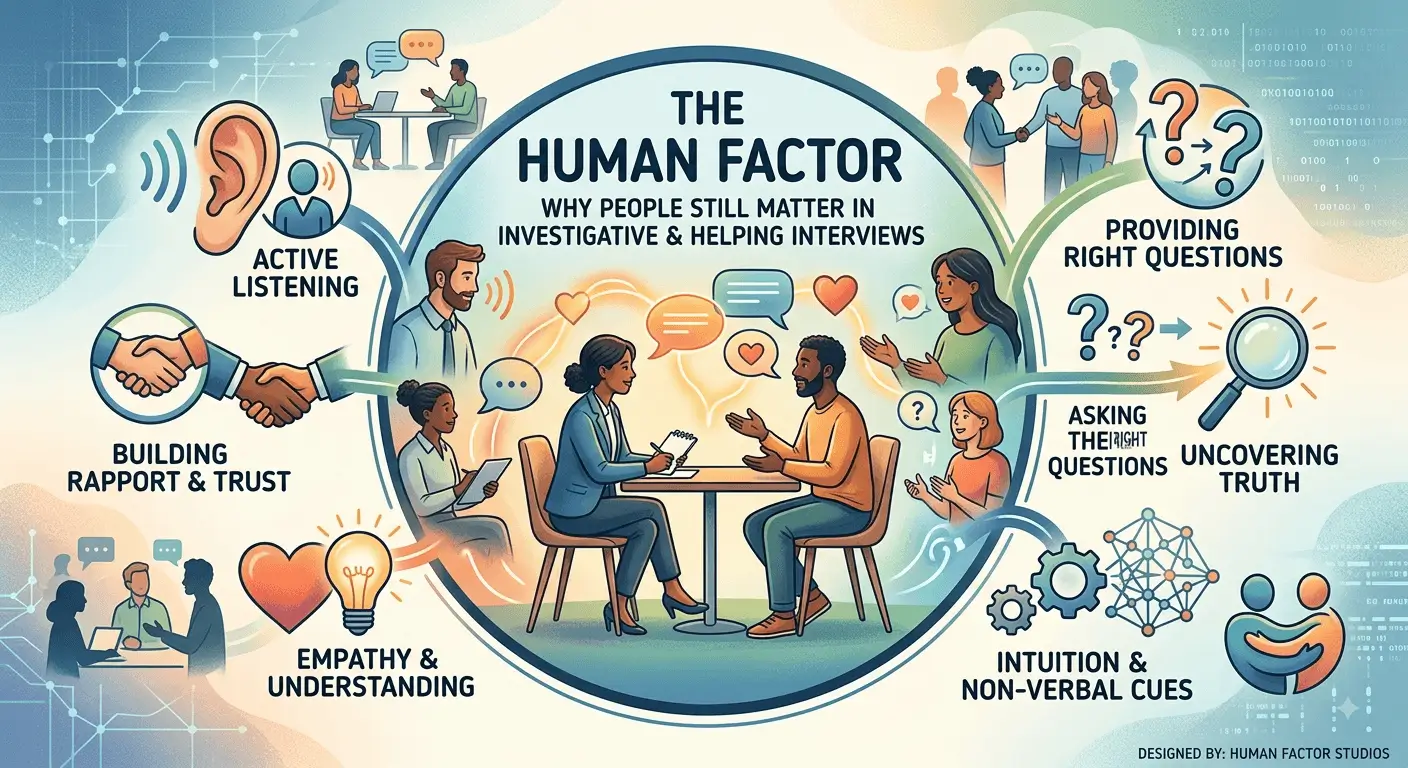
The Human Factor:
Short Description : -
Why People Still Matter in Investigative and Helping Interviews
Full Description : -
Artificial intelligence is transforming the
way organizations work. It can summarize reports in seconds, identify patterns
in large volumes of information, automate administrative tasks, and even
generate interview questions. These advancements are making workplaces more
efficient than ever before. However, when it comes to investigative interviews
and helping interviews, there remains one critical element that technology
cannot replicate—the human factor.
Whether
conducting a workplace investigation, interviewing a victim or witness,
supporting a vulnerable client, or assessing an individual's needs in human
services, the quality of the interview often determines the quality of the
outcome. An interview is far more than a series of questions and answers; it is
a human interaction built on trust, empathy, observation, and professional
judgment.
A skilled
interviewer does much more than gather facts. They recognize subtle changes in
body language, detect hesitation, respond appropriately to emotion, and adapt
their communication style to the individual sitting across from them. They
understand that every person brings unique experiences, cultural perspectives,
and personal challenges into the conversation.
While AI
can analyze words, it cannot genuinely understand fear, grief, trauma, shame,
or hope. It cannot establish rapport in the way a compassionate and
well-trained professional can. The ability to create psychological safety,
build trust, and encourage honest disclosure remains fundamentally human.This
is particularly important in helping professions such as social work,
corrections, policing, healthcare, education, victim services, and community
organizations. Individuals often disclose their most personal experiences only
when they feel respected, heard, and understood. These are qualities that
cannot simply be programmed into an algorithm.
Similarly,
investigative interviews require more than following a checklist. Professional
interviewers must balance objectivity with empathy, avoid leading questions,
recognize inconsistencies without making assumptions, and remain aware of
unconscious bias. These skills require continuous learning, deliberate
practice, and constructive feedback.
The future
is not about choosing between artificial intelligence and human expertise. It
is about using technology to support professionals while strengthening the
interpersonal skills that make interviews effective. AI can assist with
documentation, research, scheduling, and analysis, allowing professionals to
devote more attention to what matters most—people. As technology continues to
evolve, the value of exceptional communication skills will only increase.
Organizations that invest in developing skilled interviewers will improve
investigations, enhance client outcomes, strengthen workplace culture, and build
greater public trust. Professional interviewing is both an art and a science.
Like any professional competency, it can be developed, refined, and mastered
through evidence-based training, practical exercises, and ongoing coaching.
Develop the
Human Skills That Technology Cannot Replace
Menttora: Academy for
Professional Development offers
specialized training for professionals working in human services, corrections,
investigations, education, policing, healthcare, and community organizations.
Our practical, evidence-informed programs help participants develop the
interviewing skills needed to build rapport, gather accurate information,
conduct ethical investigations, and support individuals with professionalism
and compassion.
To learn more about our professional
development programs or to schedule customized organizational training:

Comments (0)
No comments yet. Be the first to comment!