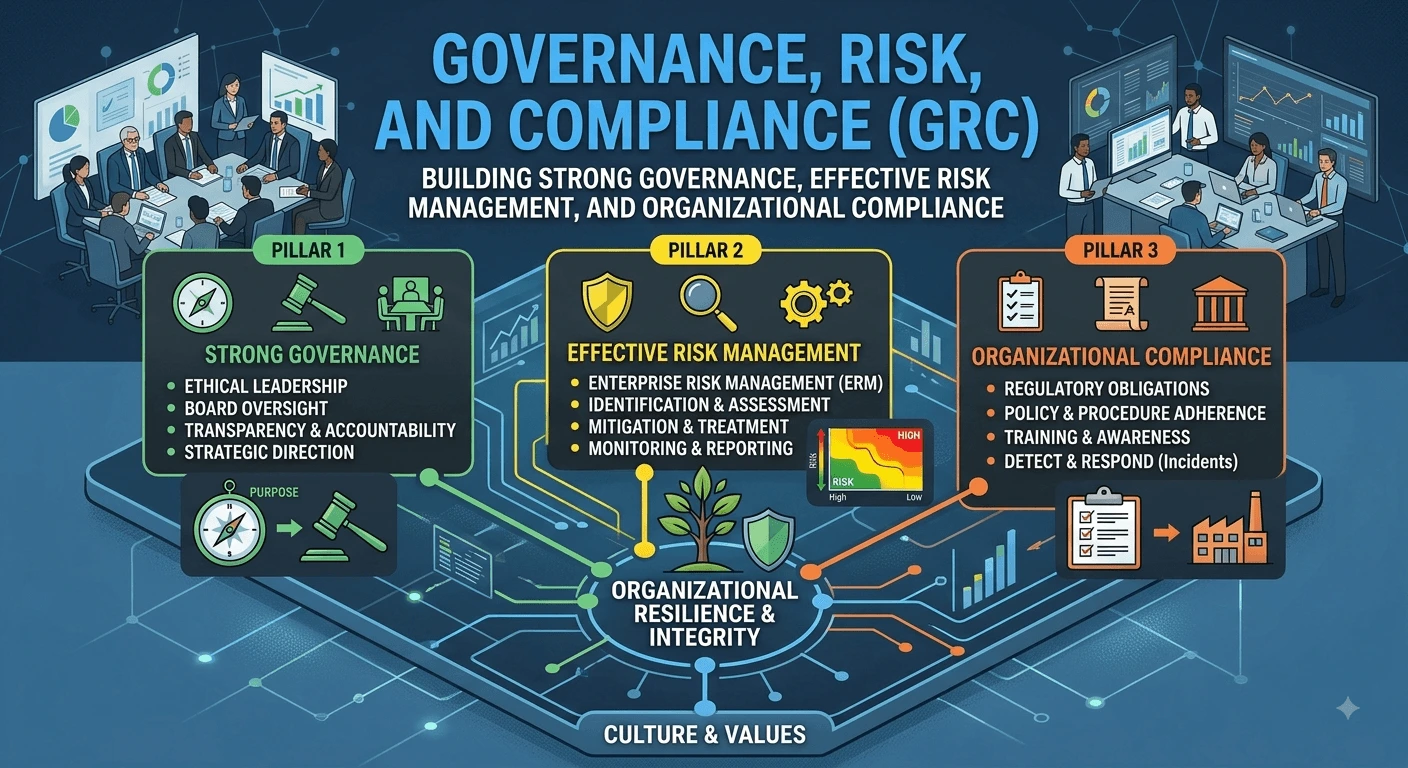
GOVERNANCE, RISK, AND COMPLIANCE (GRC)
VIEWS
74
Price
$299.00
Search Keywords : Governance Risk and Compliance (GRC) training
About Workshop
Governance Risk and Compliance (GRC) training
Building Strong Governance, Effective Risk Management, and
Organizational Compliance
Good governance is the foundation of every successful
organization. Whether in government, municipalities, corporations, non-profit
organizations, Indigenous organizations, educational institutions, healthcare,
or regulated industries, leaders must effectively manage risk, ensure legal
compliance, uphold ethical standards, and make sound decisions that promote
accountability and public trust.
Menttora: Academy for Professional Development offers
practical, evidence-informed Governance Risk and Compliance (GRC) training
designed for board members, executives, senior leaders, compliance officers,
managers, human resource professionals, lawyers, regulators, and public sector
organizations. Our workshops combine legal principles, governance best
practices, administrative fairness, ethical leadership, and risk management
strategies that participants can immediately apply within their organizations.
Governance
Principles of Good Governance This foundational workshop
introduces the core principles of good governance, including accountability,
transparency, integrity, stewardship, and organizational oversight.
Participants will explore internationally recognized governance frameworks and
practical strategies for strengthening governance effectiveness.
Governance for Boards of Directors Board members have
significant legal responsibilities, making board of directors fiduciary
oversight a critical focus area. This workshop examines governance roles,
strategic oversight, director responsibilities, committee structures,
governance best practices, and effective board performance.
Governance in the Public Sector Through our public sector
governance training, participants examine accountability, public trust,
legislative obligations, political neutrality, transparency, and ethical
decision-making tailored specifically for government agencies and public
bodies.
Corporate Governance Fundamentals This workshop explores
governance structures within corporations, including board oversight, executive
accountability, shareholder responsibilities, governance frameworks, and
regulatory expectations.
Governance for Non-Profit Organizations Participants will
learn governance principles specific to charities and non-profit organizations,
including board responsibilities, policy oversight, financial stewardship,
fundraising accountability, and strategic governance.
Governance for Municipal Councils Designed for elected
officials and municipal leaders, this workshop examines council governance,
legislative responsibilities, codes of conduct, conflicts of interest, public
accountability, committee governance, and effective decision-making.
Building High-Performing Boards Strong boards improve
organizational performance. Participants will learn practical approaches to
board recruitment, succession planning, committee effectiveness, board
evaluations, and continuous governance improvement.
Risk Management
Enterprise Risk Management (ERM) Organizations face
strategic, financial, operational, legal, and reputational risks. Our Enterprise
Risk Management (ERM) workshops introduce structured ERM frameworks, risk
identification, assessment, mitigation, monitoring, and reporting to build
long-term organizational resilience.
Risk Management for Boards Boards play a critical oversight
role in risk management. Participants will learn governance responsibilities
for enterprise risk oversight, reporting, organizational resilience, and
strategic decision-making.
Compliance
Building an Effective Compliance Program Effective corporate
compliance program development is essential for meeting regulatory
expectations. Participants will learn how to design and implement compliance
programs that support legal obligations, ethical conduct, internal controls,
policy management, monitoring, and continuous improvement.
Compliance Management Systems This workshop introduces
internationally recognized compliance management principles, governance
structures, compliance monitoring, reporting, audits, and organizational
accountability.
Regulatory Compliance Organizations operate within
increasingly complex regulatory environments. Participants will examine legal
obligations, regulatory oversight, compliance frameworks, and strategies for
reducing regulatory risk.
Developing Organizational Policies Strong policies support
good governance. Participants will learn how to develop, review, implement,
communicate, and evaluate organizational policies that align with legislation
and organizational objectives.
Internal Controls and Accountability Participants will
examine internal control systems, segregation of duties, fraud prevention,
financial accountability, governance oversight, and organizational
transparency.
Ethics and Integrity
Professional Ethics and Ethical Leadership Ethical
leadership strengthens public trust. Participants will examine ethical
decision-making, integrity, conflicts of interest, organizational values,
transparency, and accountability.
Developing an Ethical Organizational Culture Culture
influences every organizational decision. This workshop explores ethical
leadership, employee engagement, reporting mechanisms, psychological safety,
and organizational values.
Conflict of Interest Management Participants will examine
identifying, declaring, managing, and mitigating conflicts of interest while
maintaining organizational integrity and public confidence.
Code of Conduct Development and Implementation Participants
will learn how to develop practical Codes of Conduct, implement behavioural
expectations, investigate breaches, and promote ethical workplace cultures.
Investigations and Accountability
Administrative Investigations Organizations frequently
conduct internal investigations. This workshop covers investigation planning,
procedural fairness, interviewing, evidence assessment, report writing, and
defensible decision-making.
Workplace Investigations Participants will examine workplace
investigations involving harassment, discrimination, misconduct, policy
violations, and employee complaints while ensuring procedural fairness.
Investigative Interviewing Effective investigations depend
on quality interviews. Participants will develop practical interviewing
techniques that improve information gathering while maintaining fairness and
professionalism.
Procedural Fairness and Natural Justice Participants will
explore the principles of procedural fairness, including notice, disclosure,
the opportunity to respond, impartiality, and the duty to provide reasons for
decisions.
Writing Legally Defensible Decisions Well-written decisions
improve transparency and withstand legal scrutiny. Participants will learn how
to assess evidence, articulate findings of fact, apply policies and
legislation, and prepare clear written reasons.
Fraud Prevention and Organizational Integrity
Fraud Risk Management Participants will identify fraud
risks, strengthen internal controls, recognize fraud indicators, and implement
prevention and detection strategies.
Whistleblower Programs Organizations benefit from trusted
reporting systems. This workshop examines whistleblower protections, reporting
procedures, investigations, confidentiality, and organizational culture.
Financial Oversight and Accountability Board members and
executives will learn financial governance, budgeting oversight, audit
responsibilities, financial reporting, and fiduciary accountability.
Privacy and Information Governance
Privacy Law and Information Management Participants will
examine privacy legislation, information governance, records management,
confidentiality, cybersecurity, and responsible information sharing.
Records Management and Information Governance Effective
information governance reduces organizational risk. Participants will explore
records retention, information lifecycle management, privacy, security, and
digital governance.
Leadership and Organizational Excellence
Governance Leadership Leadership is central to good
governance. Participants will strengthen decision-making, accountability,
strategic thinking, ethical leadership, and governance effectiveness.
Strategic Planning and Governance Participants will learn
practical approaches to strategic planning, organizational priorities,
governance alignment, performance measurement, and implementation.
Board Evaluation and Governance Reviews Continuous
improvement strengthens governance. Participants will learn board evaluation
techniques, governance audits, performance measurement, and governance
improvement planning.
Artificial Intelligence and Governance
AI Governance Frameworks Artificial intelligence introduces
new governance challenges. Participants will learn how to develop AI governance
frameworks that address accountability, ethics, transparency, privacy, bias,
and organizational oversight.
Artificial Intelligence Risk Management Participants will
examine AI-related legal, operational, ethical, and reputational risks while
learning practical strategies for responsible AI implementation.
Developing AI Policies Organizations need clear guidance on
AI use. Participants will learn how to develop policies addressing acceptable
use, confidentiality, cybersecurity, intellectual property, human oversight,
and compliance.
Responsible AI in Decision-Making AI should support—not
replace—human judgment. This workshop explores responsible AI governance,
transparency, explainability, bias mitigation, documentation, and
accountability in organizational decision-making.
Specialized Governance Workshops
Governance During Organizational Change Change creates
governance challenges. Participants will examine governance during mergers,
restructuring, leadership transitions, and organizational transformation.
Crisis Governance Organizations must make sound decisions
during crises. This workshop explores emergency governance structures, crisis
leadership, communication, business continuity, and organizational resilience.
Governance and Organizational Culture Good governance
depends upon healthy organizational culture. Participants will examine
leadership behaviours, accountability, employee engagement, ethics, and culture
assessment.
Compliance Audits and Continuous Improvement Participants
will learn how to conduct internal compliance reviews, identify organizational
gaps, monitor performance, and implement continuous improvement initiatives.
Governance for Indigenous Organizations This workshop
explores governance principles within Indigenous organizations, balancing legal
obligations, community priorities, cultural values, accountability, and
organizational leadership.
Environmental, Social, and Governance (ESG) Governance ESG
has become a strategic priority for many organizations. Participants will
examine governance structures, ESG reporting, stakeholder expectations,
sustainability, ethical leadership, and responsible organizational practices.
Third-Party Risk Management Organizations increasingly rely
on vendors, contractors, and strategic partners. Participants will learn how to
assess third-party risks, conduct due diligence, monitor vendor performance,
manage contractual obligations, and reduce legal, operational, cybersecurity,
and reputational risks.
Business Continuity and Organizational Resilience Unexpected
disruptions can threaten organizational operations. This workshop focuses on
business continuity planning, disaster recovery, crisis response, resilience
strategies, and governance oversight to ensure organizations can continue
delivering critical services during emergencies.
Executive Masterclasses
Masterclass: Governance Excellence A comprehensive
leadership program examining advanced governance practices, board
effectiveness, organizational accountability, strategic oversight, and
governance transformation.
Masterclass: Enterprise Risk Management An intensive
workshop exploring advanced risk assessment, governance integration, strategic
risk oversight, organizational resilience, and executive decision-making.
Masterclass: Governance, Risk, and Compliance Integration
Participants will learn how governance, risk management, compliance, ethics,
investigations, internal controls, and organizational culture work together to
create high-performing, accountable organizations.
Customized Training Solutions
Menttora: Academy for Professional Development recognizes
that every organization has unique governance responsibilities, regulatory
obligations, and operational risks. Rather than delivering standardized
workshops, we work collaboratively with organizations to design customized
programs that address their specific legislative requirements, industry
standards, organizational maturity, and strategic priorities.
Workshops are available as 90-minute seminars, half-day
workshops, full-day courses, executive retreats, certificate programs, and
multi-day leadership academies, delivered in person, virtually, or in a hybrid
format.
Frequently Asked Questions (FAQ)
Q: Who should enroll in Menttora's Governance Risk and
Compliance (GRC) training? A: Our Governance Risk and Compliance (GRC)
training is designed for board members, executives, senior leaders,
compliance officers, managers, HR professionals, legal counsel, and regulators
seeking practical, evidence-informed leadership development.
Q: Do you offer specialized modules for government
bodies? A: Yes, our dedicated public sector governance training
addresses the unique legislative duties, transparency requirements, political
neutrality, and public trust obligations faced by government agencies and
municipalities.
Q: How do your Enterprise Risk Management (ERM) workshops
help organizations handle uncertainty? A: Our Enterprise Risk Management
(ERM) workshops equip participants with practical frameworks to identify,
assess, mitigate, and monitor strategic, financial, operational, legal, and
reputational risks across the enterprise.
Q: Can Menttora assist our team with corporate compliance
program development? A: Absolutely. We offer dedicated courses on corporate
compliance program development that walk organizations through designing
internal controls, policy management frameworks, and monitoring systems to
ensure legal and regulatory alignment.
Q: Does your curriculum cover board-level legal duties?
A: Yes, we provide specialized training focusing on board of directors
fiduciary oversight, guiding board members through strategic oversight,
committee structures, ethical decision-making, and legal responsibilities.
Register for this Workshop
Fill in your details below to register for this workshop.