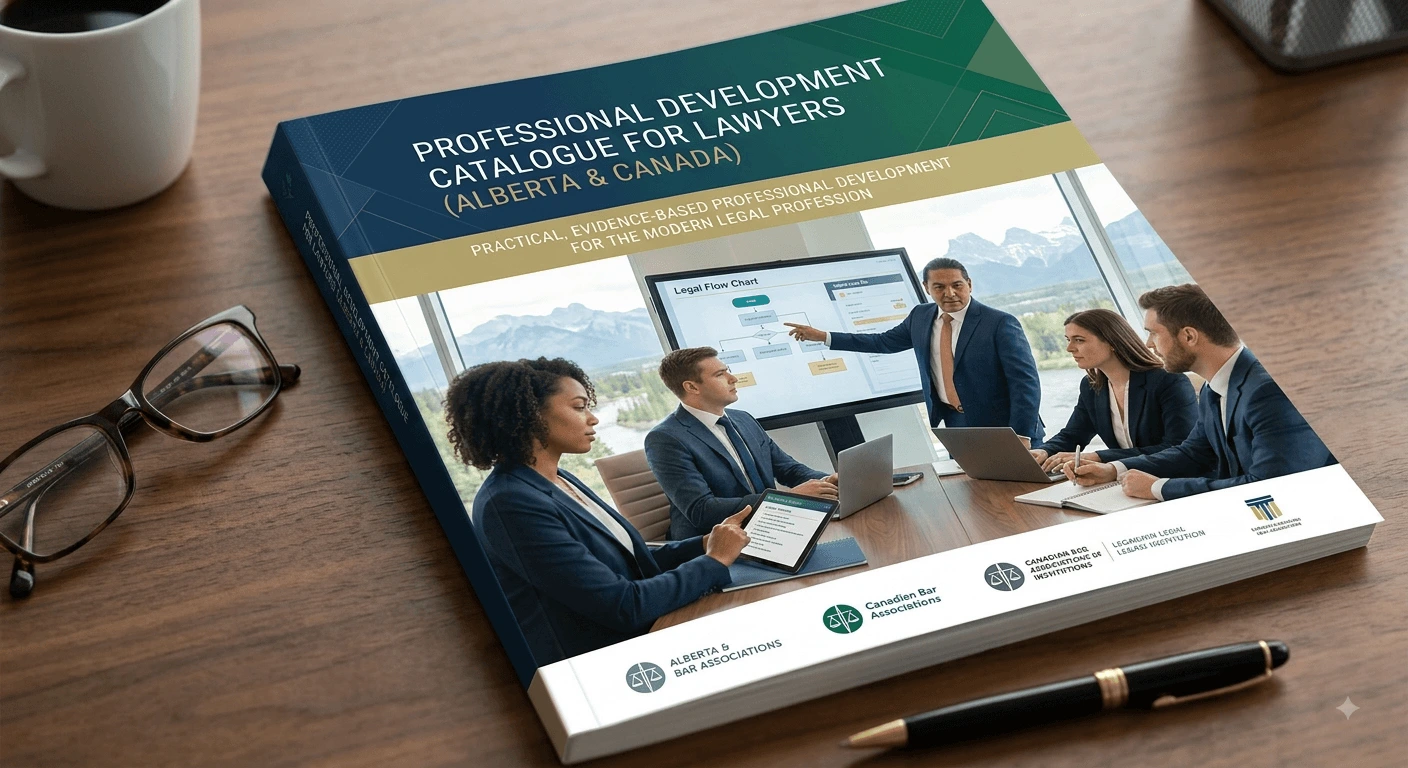
PROFESSIONAL DEVELOPMENT CATALOGUE FOR LAWYERS (ALBERTA & CANADA)
VIEWS
8
About Workshop
The
legal profession is evolving rapidly. Lawyers are expected to navigate
increasingly complex legislation, evolving case law, artificial intelligence,
workplace investigations, professional ethics, Indigenous reconciliation,
client expectations, and emerging technologies while maintaining the highest
professional standards.
Menttora:
Academy for Professional Development offers practical, research-informed
professional development designed specifically for lawyers, law firms, in-house
counsel, government lawyers, administrative decision-makers, tribunals,
municipalities, and legal organizations.
Drawing
on expertise in law, criminal justice, administrative law, governance,
investigations, human services, ethics, teaching, and public policy, our
workshops combine legal theory with practical applications that lawyers can use
immediately in their practices.
Our
workshops are structured to qualify as Continuing Professional Development
(CPD) programming.
Artificial Intelligence, Technology & the Future of Law
Artificial Intelligence for Lawyers:
Practical Applications in Legal Practice
Artificial
intelligence is transforming legal practice. This workshop teaches lawyers how
to ethically and effectively use AI for legal research, drafting
correspondence, summarizing evidence, preparing litigation materials, reviewing
contracts, developing policies, and improving productivity, while recognizing
its limitations and maintaining professional judgment.
Ethical Use of Artificial
Intelligence
The
use of AI creates significant ethical responsibilities for lawyers.
Participants will examine confidentiality, privilege, accuracy, bias,
supervision of AI-generated work, client disclosure, cybersecurity, and
professional obligations when integrating AI into legal practice.
Developing AI Policies for Law Firms
Law
firms require governance around AI use. Participants will learn how to develop
practical office policies addressing confidentiality, risk management, quality
assurance, data security, acceptable use, and professional accountability.
Cybersecurity and Privacy for Legal
Professionals
Law
firms remain frequent targets of cybercrime. This workshop examines
cybersecurity fundamentals, phishing prevention, ransomware risks, cloud
security, client confidentiality, breach response planning, and privacy
obligations.
Professional Responsibility & Ethics
Legal Ethics Beyond the Rules
Professional
responsibility extends beyond compliance. This workshop explores ethical
decision-making, conflicts of interest, confidentiality, professionalism,
integrity, civility, and maintaining public confidence in the legal profession.
Professionalism and Civility in Legal
Practice
Increasing
conflict within litigation and professional interactions requires renewed focus
on civility. Participants will learn practical strategies for maintaining
professionalism with opposing counsel, clients, courts, and colleagues while
advocating effectively.
Managing Difficult Clients
Lawyers
frequently represent clients experiencing stress, trauma, anger, or unrealistic
expectations. This workshop provides practical strategies for client
communication, expectation management, conflict resolution, and maintaining
professional boundaries.
Administrative Law & Decision-Making
Administrative Law: Practical
Principles for Lawyers
Administrative
law continues to evolve rapidly. Participants will examine standards of review,
procedural fairness, jurisdiction, statutory interpretation, tribunal advocacy,
and current developments affecting administrative decision-making.
Procedural Fairness and Natural
Justice
Procedural
fairness remains central to administrative decision-making. Participants will
review notice requirements, disclosure obligations, the right to be heard,
bias, written reasons, and procedural fairness in tribunals, municipalities,
universities, and regulatory bodies.
Judicial Review: Building Defensible
Decisions
Participants
will learn what courts look for during judicial review, common procedural
errors, writing defensible decisions, evidentiary considerations, and avoiding
successful judicial review applications.
Writing Effective Administrative
Decisions
Clear
written decisions improve fairness and withstand legal scrutiny. Participants
will learn how to organize findings of fact, assess evidence, articulate
credibility findings, apply legislation, and write persuasive reasons.
Investigations & Interviewing
Investigative Interviewing for
Lawyers
Successful
investigations begin with effective interviews. Participants will develop
practical interviewing techniques, questioning strategies, rapport building,
credibility assessment, statement analysis, trauma-informed interviewing, and
documentation practices.
Conducting Workplace Investigations
Workplace
investigations continue to be one of the fastest-growing areas of legal
practice. This workshop examines investigation planning, procedural fairness,
witness interviews, evidence assessment, report writing, and legal risk
management.
Conducting Trauma-Informed Interviews
Many
clients have experienced trauma. Participants will learn trauma-informed
communication techniques that improve information gathering while reducing the
risk of retraumatization.
Investigative Bias and
Decision-Making
Cognitive
bias affects investigations and legal analysis. Participants will explore
confirmation bias, tunnel vision, implicit bias, credibility assessment, and
evidence-based decision-making.
Litigation Skills
Evidence Assessment and Credibility
Analysis
Participants
will strengthen their ability to assess witness credibility, evaluate
conflicting evidence, identify inconsistencies, and develop objective factual
findings.
Preparing
Witnesses for Testimony
Witness
preparation is critical to successful litigation. Participants will examine
ethical witness preparation, courtroom communication, managing difficult
witnesses, and preparing clients for cross-examination.
Courtroom Advocacy Skills
Participants
will develop practical advocacy skills including persuasive submissions, oral
advocacy, organization of evidence, courtroom professionalism, and effective
communication.
Workplace Law
Psychological Safety in the Workplace
Psychological
safety has become an increasingly important legal and organizational issue.
Participants will examine employer obligations, respectful workplaces,
psychological harassment, leadership responsibilities, and organizational
culture.
Workplace Harassment Investigations
This
workshop examines legal obligations surrounding harassment investigations,
procedural fairness, documentation, interviewing, findings, recommendations,
and post-investigation risk management.
Human Rights in Employment
Participants
will review Alberta and federal human rights legislation, accommodation
obligations, discrimination, protected grounds, workplace investigations, and
practical case studies.
Governance & Risk Management
Governance for Boards and Executive
Leaders
Lawyers
frequently advise boards of directors. Participants will examine fiduciary
duties, governance structures, director liability, strategic oversight,
conflicts of interest, and governance best practices.
Legal Risk Management
Organizations
increasingly seek proactive legal advice. Participants will learn practical
risk identification, compliance strategies, governance frameworks, policy
development, and enterprise risk management.
Municipal Governance and
Administrative Decision-Making
Designed
for lawyers advising municipalities or public bodies, this workshop examines
council governance, codes of conduct, procedural fairness, administrative
investigations, conflicts of interest, and governance accountability.
Indigenous Law & Reconciliation
Truth and Reconciliation: Practical
Implications for Lawyers
Participants
will explore the Truth and Reconciliation Commission's Calls to Action,
Indigenous legal traditions, cultural competency, historical context, and
practical implications for legal practice.
Working Effectively with Indigenous
Clients and Communities
Lawyers
will develop culturally responsive communication skills, improve understanding
of Indigenous perspectives, and strengthen professional relationships with
Indigenous clients and communities.
Criminal Justice
Emerging Issues in Canadian Criminal
Justice
This
workshop explores current trends in criminal justice, sentencing developments,
corrections, offender reintegration, policing, restorative justice, and
emerging public policy issues.
Restorative Justice in Legal Practice
Participants
will examine restorative justice principles, victim-offender dialogue,
community-based justice models, diversion programs, and opportunities for
restorative approaches within Canadian law.
Legal Writing
Advanced Legal Writing
Strong
legal writing remains one of the profession's most valuable skills.
Participants will improve clarity, organization, persuasive writing, legal
analysis, decision writing, and plain-language drafting.
Writing Better Policies and
Governance Documents
Lawyers
increasingly draft organizational policies. Participants will learn best
practices for developing legally sound, practical, and enforceable
organizational policies and governance documents.
Mental Health & Lawyer Wellness
Lawyer Wellness and Burnout
Prevention
Burnout
is increasingly affecting the legal profession. Participants will examine
resilience, workload management, compassion fatigue, mental health, stress
reduction, and strategies for maintaining long-term professional effectiveness.
Emotional Intelligence for Lawyers
Technical
expertise alone is insufficient for successful practice. Participants will
strengthen communication, negotiation, conflict management, leadership,
empathy, and client relationship skills through emotional intelligence.
Specialized High-Demand Workshops
AI Prompt Engineering for Lawyers
Learn
how to write effective prompts that produce accurate, useful, and efficient
legal outputs while maintaining professional responsibility and independent
legal judgment.
ChatGPT Masterclass for Lawyers
An
advanced hands-on workshop demonstrating how lawyers can safely integrate
ChatGPT into research, drafting, client communication, litigation support,
policy development, and legal education.
Ethics of Remote Practice and Virtual
Law Firms
Participants
will examine ethical obligations related to virtual practice, electronic
communication, cybersecurity, client identification, cloud storage, and
maintaining competence in a digital environment.
Effective Decision-Making Under
Uncertainty
Lawyers
frequently advise clients without complete information. This workshop explores
structured decision-making frameworks, risk assessment, cognitive bias
mitigation, and practical approaches to managing legal uncertainty.
Mediation, Negotiation and Conflict
Resolution
This
practical workshop develops negotiation techniques, interest-based bargaining,
mediation strategies, communication skills, and dispute resolution approaches
that help lawyers resolve conflicts efficiently while preserving professional
relationships.
Digital Documentation and Record
Management
Participants
will learn best practices for electronic record keeping, secure documentation,
digital communication, cybersecurity awareness, and protecting confidential
client information.
Executive Masterclasses
Masterclass: Administrative
Investigations
A
comprehensive program covering investigation planning, interviewing, evidence
evaluation, credibility assessment, procedural fairness, report writing, and
defending investigative findings.
Masterclass: Administrative Decision
Writing
Participants
will complete practical exercises on writing legally defensible decisions
capable of withstanding judicial scrutiny, focusing on evidence analysis,
findings of fact, statutory interpretation, and clear reasons.
Masterclass: AI Transformation for
Law Firms
A
strategic program for partners and firm leaders on implementing AI responsibly,
developing governance frameworks, managing risk, training staff, and improving
operational efficiency.
Customized CPD Programs
Menttora:
Academy for Professional Development specializes in designing customized
Continuing Professional Development (CPD) programs tailored to the unique
needs of law firms, corporate legal departments, government legal services,
municipalities, regulatory bodies, tribunals, and legal associations.
Training
can be delivered as 90-minute seminars, half-day workshops, full-day
courses, executive retreats, or multi-day certificate programs, either in
person, virtually, or in a hybrid format.
Register for this Workshop
Fill in your details below to register for this workshop.