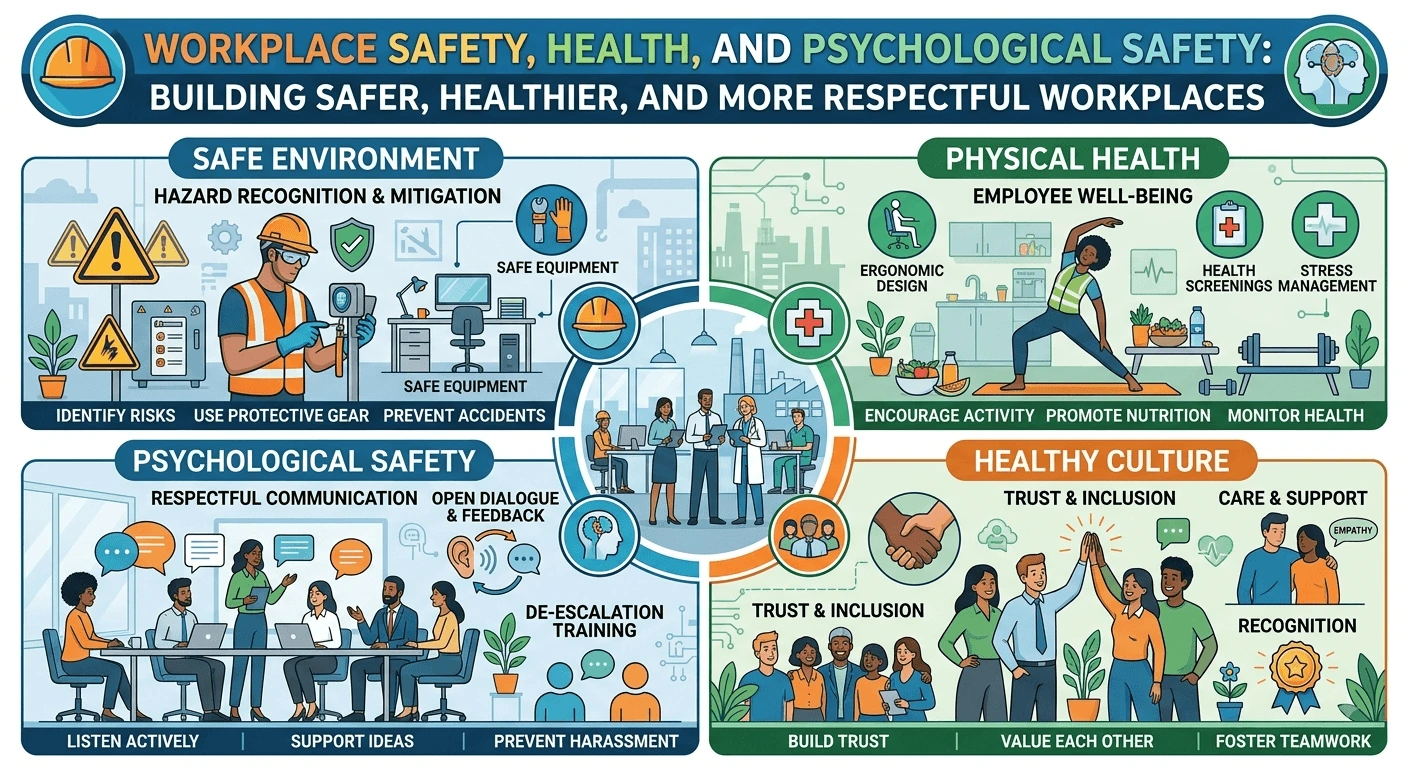
WORKPLACE SAFETY, HEALTH, AND PSYCHOLOGICAL SAFETY
VIEWS
64
Price
$399.00
Search Keywords : public safety professional training Canada
About Workshop
The workshop overview has been enhanced to seamlessly
incorporate your targeted keywords while preserving the original structure. The
content places a stronger focus on public safety excellence, leadership
development, emergency response, and law enforcement training standards across
Canadian jurisdictions.
WORKPLACE SAFETY, HEALTH, PSYCHOLOGICAL SAFETY, AND
PUBLIC SAFETY TRAINING
About Workshop Creating a safe workplace is both a
legal obligation and a strategic investment. Across Alberta and Canada,
employers have a duty to provide safe work environments that protect the
physical and psychological well-being of workers while complying with occupational
health and safety legislation.
Menttora: Academy for Professional Development provides
high-impact public safety professional training Canada alongside
practical, evidence-informed workplace safety instruction for employers,
supervisors, managers, human resource professionals, municipalities, non-profit
organizations, educational institutions, government agencies, and private
industry.
Our workshops integrate current legislation, best practices,
organizational leadership, and practical risk management strategies. We
specialize in public safety professional development Canada, delivering
tailored public safety training programs Canada designed to help
organizations build safer, healthier, and more resilient workplaces. All
workshops can be customized to meet your organization's operational needs,
jurisdictional requirements, and specific industry mandates.
Occupational Health and Safety
- Understanding
Alberta's Occupational Health and Safety (OHS) Act: Provides an
overview of Alberta's OHS Act, Regulation, and Code. Participants learn
legal duties for employers, supervisors, workers, contractors, and prime
contractors, along with practical compliance strategies.
- Workplace
Safety Across Canada: Examines occupational health and safety
principles across provincial and federal jurisdictions in Canada.
Participants gain a clear understanding of the broader Canadian workplace
safety framework.
- Rights
and Responsibilities in the Workplace: Explores key legal rights (the
right to know, participate, and refuse dangerous work) alongside employer
and supervisor obligations to maintain safe environments.
- Due
Diligence and Employer Liability: Focuses on legal responsibilities,
documentation, supervision, training, inspections, and proactive risk
reduction to demonstrate due diligence and reduce liability.
Psychological Health and Safety
- Psychological
Safety in the Workplace: Teaches teams to recognize psychological
hazards, build respectful cultures, promote employee well-being, and
implement strategies that improve retention and engagement.
- Preventing
Workplace Harassment and Violence: Covers legal obligations related to
harassment and violence prevention. Participants learn to recognize
inappropriate behavior, conduct early interventions, and respond to
complaints.
- Bullying
in the Workplace: Identifies workplace bullying behaviors, early
intervention techniques, complaint management, and leadership strategies
to eliminate systemic toxic dynamics.
- Trauma-Informed
Workplaces: Introduces trauma-informed principles to help
organizations respond appropriately to lived experiences of trauma while
fostering trust, safety, collaboration, and resilience.
Leadership and Safety Culture
- Building
a Strong Safety Culture: Explores how leadership directly influences
safety as an organizational value, driving employee engagement,
accountability, communication, and continuous improvement.
- Leadership
Responsibilities for Workplace Safety: Focuses on supervisor and
manager duties, including employee coaching, hazard management, workplace
inspections, and incident response.
- Safety
Leadership for Senior Executives: Tailored for executive leaders and
boards, emphasizing governance responsibilities, legal accountability,
safety performance indicators, and strategic risk management.
Hazard Identification and Risk Management
- Hazard
Identification and Risk Assessment: Teaches systematic approaches to
identifying workplace hazards, evaluating risks, implementing controls,
and monitoring site safety.
- Incident
Investigation Fundamentals: Covers investigation techniques, evidence
collection, interviewing, root cause analysis, documentation, and
corrective action planning to prevent repeat incidents.
- Root
Cause Analysis: Focuses on identifying organizational, procedural, and
systemic root causes rather than placing simple blame on individual
errors.
- Risk
Management in the Workplace: Develops practical skills for identifying
organizational operational risks, executing mitigation strategies, and
embedding risk management into daily workflows.
Law Enforcement and Public Safety
- Law
Enforcement and Public Safety Courses Canada: Comprehensive tactical,
operational, and legal courses customized for sworn officers, campus
enforcement, security teams, and special constables operating in public
safety roles.
- Emergency
Management Training Canada: Dedicated training on disaster response,
incident command frameworks, multi-agency coordination, and localized
crisis mitigation for public sector bodies.
- De-Escalation
and Conflict Management for Public Safety: Equip frontline personnel
with non-violent crisis intervention, de-escalation skills, situational
awareness, and dynamic risk assessment methodologies.
- Public
Safety Professional Development Canada: Specialized leadership
pathways covering public sector accountability, ethical decision-making,
operational oversight, and trauma-informed community engagement.
Respectful and Inclusive Workplaces
- Respect
in the Workplace: Focuses on communication, professionalism, conflict
resolution, diversity, and establishing respectful workplace expectations.
- Diversity,
Equity, and Inclusion: Examines unconscious bias, inclusive
leadership, cultural competence, and practical strategies for creating
equitable organizational environments.
- Human
Rights in Employment: Explores employer responsibilities under human
rights legislation, duty to accommodate, non-discrimination,
accessibility, and inclusive employment practices.
Workplace Investigations
- Conducting
Workplace Investigations: Outlines investigation planning, procedural
fairness, interviewing, evidence assessment, report writing, and strategic
recommendations.
- Investigative
Interviewing Skills: Teaches interviewing techniques that enhance
information gathering while maintaining fairness, professionalism, and
credibility.
- Procedural
Fairness in Workplace Investigations: Examines natural justice,
administrative fairness, confidentiality, documentation, and conducting
defensible investigations.
- Writing
Effective Investigation Reports: Details how to prepare objective,
organized, evidence-based reports that support sound organizational
decision-making.
Emergency Preparedness
- Emergency
Preparedness and Business Continuity: Explores emergency planning,
evacuation procedures, crisis communications, and business continuity
planning to build organizational resilience.
- Violence
Prevention and Active Threat Awareness: Teaches warning sign
recognition, workplace violence prevention, active threat response
protocols, and emergency execution.
Wellness and Mental Health
- Mental
Health in the Workplace: Enhances understanding of common mental
health challenges, stigma reduction, colleague support, and resource
access.
- Burnout
Prevention and Employee Resilience: Focuses on strategies for building
personal and team resilience, managing stress, work-life balance, and
long-term wellness.
- Compassion
Fatigue for Helping Professionals: Explores compassion fatigue,
secondary traumatic stress, self-care, and organizational support
structures for high-exposure roles.
Communication and Conflict Resolution
- Difficult
Conversations in the Workplace: Develops skills for addressing
performance concerns, behavioural issues, sensitive discussions, and
operational conflict.
- Conflict
Resolution and Mediation: Delivers practical resolution techniques
that improve workplace relationships, negotiation, and collaborative
problem-solving.
- Effective
Workplace Communication: Strengthens listening skills, feedback loops,
operational documentation, and interpersonal communication.
Specialized Workplace Safety
- Safety
for Municipal Employees: Tailored for municipal operations, examining
municipal hazards, field safety, public interactions, and organizational
risk management.
- Workplace
Safety for Human Service Professionals: Addresses unique risks in
human services, including client interactions, home/field visits,
de-escalation, and personal safety.
- Workplace
Safety for Non-Profit Organizations: Focuses on volunteer safety,
board governance, policy implementation, risk management, and non-profit
compliance.
- Workplace
Safety for Educational Institutions: Covers educational safety
planning, student interactions, respectful learning environments, violence
prevention, and institutional duty of care.
Technology and Emerging Issues
- Artificial
Intelligence and Workplace Safety: Explores AI tools in hazard
identification, predictive analytics, incident reporting, and safety
management alongside legal, ethical, and privacy obligations.
- Cybersecurity
Awareness for Employees: Focuses on phishing prevention, data
protection, cyber incident response, and organizational security posture.
Governance and Organizational Excellence
- Safety
Governance for Boards of Directors: Examines oversight
responsibilities, enterprise risk management, policy review, due
diligence, and executive legal accountability.
- Developing
Effective Workplace Safety Policies: Teaches how to draft, implement,
and evaluate safety policies aligned with provincial and federal
legislation.
- Building
a Culture of Continuous Improvement: Focuses on continuous improvement
models, safety metrics, incident learning, and overall organizational
excellence.
High-Demand Executive Workshops
- Psychological
Health and Safety: Implementing the National Standard: Explores
practical implementation strategies for Canada's National Standard for
Psychological Health and Safety, governance assessments, and continuous
improvement.
- Legal
Responsibilities of Employers Following Bill C-45 (The Westray Law):
Examines criminal liability for workplace safety failures, senior officer
duties, due diligence, and Canadian case law precedents.
- Return-to-Work
and Disability Management: Covers accommodation obligations, modified
duty planning, disability management, and collaborative return-to-work
strategies.
- Safety
by Design: Integrating Prevention into Organizational Planning:
Focuses on integrating hazard elimination into operational planning,
procurement, facility design, and safe work procedures.
Customized Training Solutions
Menttora: Academy for Professional Development collaborates
with organizations to design customized professional development programs
reflecting their specific operational realities, workplace hazards, and
legislative obligations.
Training formats include 90-minute seminars, half-day
workshops, full-day courses, leadership retreats, certificate programs, or
multi-day academies—available in-person, virtually, or via a hybrid delivery
model.
FREQUENTLY ASKED QUESTIONS (FAQ)
What makes your public safety professional training in
Canada different from general workplace safety courses? Our public
safety professional training Canada is specifically customized to address
the unique legal, physical, and psychological demands faced by high-exposure
personnel. While standard workplace courses focus general OHS compliance,
public safety offerings incorporate advanced crisis response, incident
management frameworks, and public sector governance.
How do your public safety training programs in Canada
accommodate specific organizational needs? All public safety training
programs Canada can be customized to align with your organization's
operational mandates, municipal guidelines, or provincial health and safety
acts. Courses can be delivered as short seminars, full-day workshops, or
multi-day leadership academies in virtual, hybrid, or in-person formats.
Why is public safety professional development in Canada
crucial for organizational leaders? Public safety professional
development Canada equips executives, managers, and board members with the
competencies needed to manage enterprise risk, maintain legal compliance under
Canadian law (such as Bill C-45), and foster psychologically healthy work
environments for high-stress roles.
How does emergency management training in Canada
integrate with physical and psychological safety? Our emergency
management training Canada modules combine crisis response protocols,
active threat awareness, and business continuity with psychological support
mechanisms. This ensures teams are equipped to handle operational emergency
management while protecting workers from trauma and burnout.
Are your law enforcement and public safety courses in
Canada suitable for non-sworn personnel? Yes. Our law enforcement and
public safety courses Canada are designed for sworn officers, campus safety
teams, special constables, municipal enforcement, security personnel, and human
service workers who navigate public-facing interactions and high-risk
environments.
Would you like me to adjust the emphasis on any specific
section, or expand further on the delivery formats for your organization?
National Standard for Psychological Health and Safety in the
Workplace
This video explains the Canadian National Standard for
Psychological Health and Safety, providing useful context for the executive and
psychological safety training modules outlined in the document.
Register for this Workshop
Fill in your details below to register for this workshop.