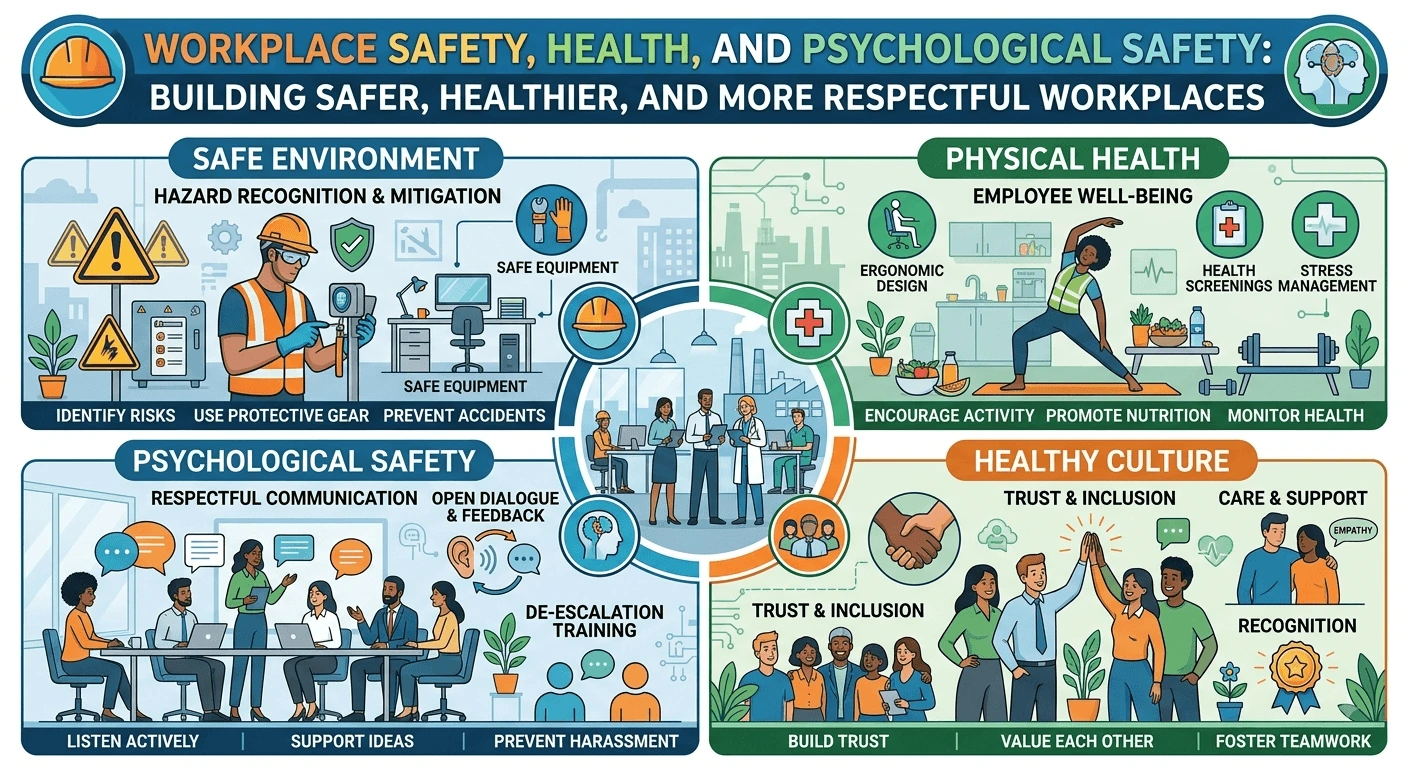
WORKPLACE SAFETY, HEALTH, AND PSYCHOLOGICAL SAFETY
VIEWS
13
About Workshop
Creating a safe workplace is both a legal
obligation and a strategic investment. Across Alberta and Canada, employers
have a duty to provide safe work environments that protect the physical and
psychological well-being of workers while complying with occupational health
and safety legislation.
Menttora: Academy for Professional
Development provides practical, evidence-informed workplace safety training for
employers, supervisors, managers, human resource professionals, municipalities,
non-profit organizations, educational institutions, government agencies, and
private industry.
Our workshops integrate current
legislation, best practices, organizational leadership, and practical risk
management strategies to help organizations build safer, healthier, and more
productive workplaces.
All workshops can be customized to meet
your organization's operational needs and industry requirements.
Occupational Health and Safety
Understanding Alberta's Occupational
Health and Safety (OHS) Act
This foundational workshop provides
participants with an overview of Alberta's Occupational Health and Safety Act,
Regulation, and Code. Participants will learn the legal duties of employers,
supervisors, workers, contractors, and prime contractors, along with practical
strategies for maintaining legislative compliance.
Workplace Safety Across Canada
This workshop examines occupational health
and safety principles across Canada, highlighting common legal obligations
while exploring key differences between provincial and federal jurisdictions.
Participants will gain a practical understanding of Canada's workplace safety
framework.
Rights and Responsibilities in the
Workplace
Every worker has legal rights and
responsibilities. Participants will explore the right to know, the right to
participate, and the right to refuse dangerous work, while examining employer
and supervisor obligations to maintain safe workplaces.
Due Diligence and Employer Liability
Demonstrating due diligence is one of the
most important legal protections available to employers. This workshop explores
legal responsibilities, documentation, supervision, training, inspections, and
proactive measures organizations can implement to reduce liability.
Psychological Health and Safety
Psychological Safety in the Workplace
Healthy workplaces are both physically and
psychologically safe. Participants will learn how to recognize psychological
hazards, build respectful workplace cultures, promote employee well-being, and
implement strategies that improve engagement and retention.
Preventing Workplace Harassment and
Violence
This workshop examines legal obligations
related to harassment and workplace violence prevention. Participants will
learn how to recognize inappropriate behaviour, respond effectively to
complaints, conduct early interventions, and foster respectful workplace
cultures.
Bullying in the Workplace
Bullying negatively affects employees and
organizations alike. Participants will explore identifying workplace bullying,
early intervention strategies, complaint management, leadership
responsibilities, and prevention techniques.
Trauma-Informed Workplaces
Employees may bring lived experiences of
trauma into the workplace. This workshop introduces trauma-informed principles
that help organizations respond appropriately while fostering safety, trust,
collaboration, and resilience.
Leadership and Safety Culture
Building a Strong Safety Culture
Safety is more than compliance—it is an
organizational value. Participants will learn how leadership influences
workplace culture, employee engagement, accountability, communication, and
continuous improvement.
Leadership Responsibilities for
Workplace Safety
Supervisors and managers play a critical
role in maintaining safe workplaces. This workshop examines legal obligations,
coaching employees, conducting inspections, managing hazards, and responding to
workplace incidents.
Safety Leadership for Senior
Executives
Designed for executive leaders and boards,
this workshop focuses on governance responsibilities, organizational risk,
legal accountability, safety performance indicators, and integrating safety
into strategic planning.
Hazard Identification and Risk Management
Hazard Identification and Risk
Assessment
Participants will learn systematic
approaches to identifying workplace hazards, evaluating risks, implementing
controls, and continuously monitoring workplace safety.
Incident Investigation Fundamentals
Learning from workplace incidents prevents
future injuries. Participants will examine investigation techniques, root cause
analysis, evidence collection, interviewing, documentation, and corrective
action planning.
Root Cause Analysis
Rather than focusing solely on individual
mistakes, this workshop teaches participants how to identify organizational,
procedural, and systemic factors contributing to workplace incidents.
Risk Management in the Workplace
Participants will develop practical skills
for identifying organizational risks, implementing mitigation strategies, and
integrating risk management into daily operations.
Respectful and Inclusive Workplaces
Respect in the Workplace
Respectful workplaces improve employee
satisfaction and organizational performance. Participants will explore
communication, professionalism, conflict resolution, diversity, inclusion, and
respectful workplace expectations.
Diversity, Equity and Inclusion
Inclusive workplaces strengthen
organizations. Participants will examine unconscious bias, inclusive
leadership, cultural competence, accessibility, and practical strategies for
creating equitable workplaces.
Human Rights in Employment
This workshop explores employer
responsibilities under human rights legislation, duty to accommodate,
discrimination, harassment, accessibility, and creating inclusive employment
practices.
Workplace Investigations
Conducting
Workplace Investigations
Organizations must respond fairly and
promptly to workplace complaints. Participants will learn investigation
planning, procedural fairness, interviewing techniques, evidence assessment,
report writing, and recommendations.
Investigative Interviewing Skills
Successful investigations depend upon
quality interviews. Participants will develop interviewing techniques that
improve information gathering while maintaining fairness, professionalism, and
credibility.
Procedural Fairness in Workplace
Investigations
Participants will examine natural justice,
administrative fairness, confidentiality, documentation, and conducting legally
defensible workplace investigations.
Writing Effective Investigation
Reports
Participants will learn how to prepare
objective, organized, evidence-based investigation reports capable of
supporting sound organizational decision-making.
Emergency Preparedness
Emergency Preparedness and Business
Continuity
Organizations must be prepared for
emergencies. Participants will examine emergency planning, evacuation
procedures, crisis communications, business continuity planning, and
organizational resilience.
Violence Prevention and Active Threat
Awareness
Participants will learn strategies for
recognizing warning signs, preventing workplace violence, responding to
threatening situations, and developing organizational emergency response
protocols.
Wellness and Mental Health
Mental Health in the Workplace
Participants will develop a better
understanding of common mental health challenges, reducing stigma, supporting
colleagues, recognizing warning signs, and accessing available resources.
Burnout Prevention and Employee
Resilience
High workplace demands can lead to burnout.
Participants will learn practical strategies for building resilience, managing
stress, improving work-life balance, and supporting long-term employee
wellness.
Compassion Fatigue for Helping
Professionals
Helping professions face unique workplace
risks. Participants will explore compassion fatigue, secondary traumatic
stress, resilience, self-care, and organizational supports.
Communication and Conflict Resolution
Difficult Conversations in the
Workplace
Participants will develop practical
communication skills for addressing performance concerns, conflict, behavioural
issues, and sensitive workplace discussions.
Conflict
Resolution and Mediation
This workshop provides practical conflict
resolution techniques that improve workplace relationships, communication,
negotiation, and collaborative problem-solving.
Effective Workplace Communication
Clear communication improves safety and
teamwork. Participants will strengthen listening, feedback, documentation, and
interpersonal communication skills.
Specialized Workplace Safety
Safety for Municipal Employees
Designed for municipalities, this workshop
examines workplace hazards encountered by municipal employees, legal
responsibilities, public interactions, field work, and organizational risk
management.
Workplace Safety for Human Service
Professionals
Human service professionals encounter
unique safety challenges. Participants will examine client interactions, field
visits, home visits, de-escalation, documentation, and personal safety
strategies.
Workplace Safety for Non-Profit
Organizations
Non-profit organizations face unique
operational risks. This workshop focuses on volunteer safety, governance
responsibilities, risk management, workplace policies, and legal compliance.
Workplace Safety for Educational
Institutions
Educational environments require
specialized safety planning. Participants will examine violence prevention,
respectful learning environments, emergency preparedness, student interactions,
and organizational responsibilities.
Technology and Emerging Issues
Artificial Intelligence and Workplace
Safety
Artificial intelligence is changing
workplace operations. Participants will explore how AI can support hazard
identification, incident reporting, predictive analytics, training, and safety
management while understanding legal, ethical, and privacy considerations.
Cybersecurity Awareness for Employees
Cybersecurity is an essential component of
workplace safety. Participants will learn to recognize phishing attempts,
protect sensitive information, respond to cyber incidents, and strengthen
organizational security.
Governance and Organizational Excellence
Safety Governance for Boards of
Directors
Boards have oversight responsibilities for
organizational safety. This workshop examines governance frameworks, due
diligence, policy oversight, enterprise risk management, and legal
accountability.
Developing Effective Workplace Safety
Policies
Strong policies support legal compliance
and organizational consistency. Participants will learn how to develop, review,
implement, and evaluate workplace safety policies aligned with legislation and
best practices.
Building a Culture of Continuous
Improvement
Organizations that continuously improve
achieve better safety outcomes. Participants will explore quality improvement
models, performance measurement, incident learning, employee engagement, and
organizational excellence.
High-Demand Executive Workshops
Psychological Health and Safety:
Implementing the National Standard
This workshop explores Canada's National
Standard for Psychological Health and Safety in the Workplace. Participants
will learn practical implementation strategies, governance considerations,
organizational assessments, and continuous improvement planning.
Legal Responsibilities of Employers
Following Bill C-45 (The Westray Law)
Participants will examine criminal
liability for workplace safety failures under Bill C-45, including the legal
duties of organizations and senior officers, due diligence principles, and
lessons learned from Canadian case law.
Return-to-Work and Disability
Management
This workshop focuses on accommodation
obligations, return-to-work planning, modified duties, disability management,
and collaboration among employers, employees, healthcare providers, and
insurers to support successful workplace reintegration.
Safety by Design: Integrating
Prevention into Organizational Planning
Rather than reacting to incidents,
organizations can design safety into every aspect of their operations.
Participants will learn proactive approaches to hazard elimination, safe work
procedures, procurement, facility design, and organizational planning.
Customized Training Solutions
Menttora: Academy for Professional
Development recognizes that every organization has unique workplace hazards,
legislative obligations, and operational challenges. Rather than offering
one-size-fits-all training, we collaborate with organizations to design
customized professional development programs that reflect their industry,
workforce, and organizational priorities.
Training can be delivered as 90-minute
seminars, half-day workshops, full-day courses, leadership retreats,
certificate programs, or multi-day academies, available in person,
virtually, or in a hybrid format.
Our evidence-informed approach combines
occupational health and safety legislation, organizational governance,
leadership development, human factors, workplace investigations, psychological
safety, and risk management to help organizations create safer workplaces,
reduce liability, strengthen compliance, and foster a culture of health,
safety, and respect.
Register for this Workshop
Fill in your details below to register for this workshop.